
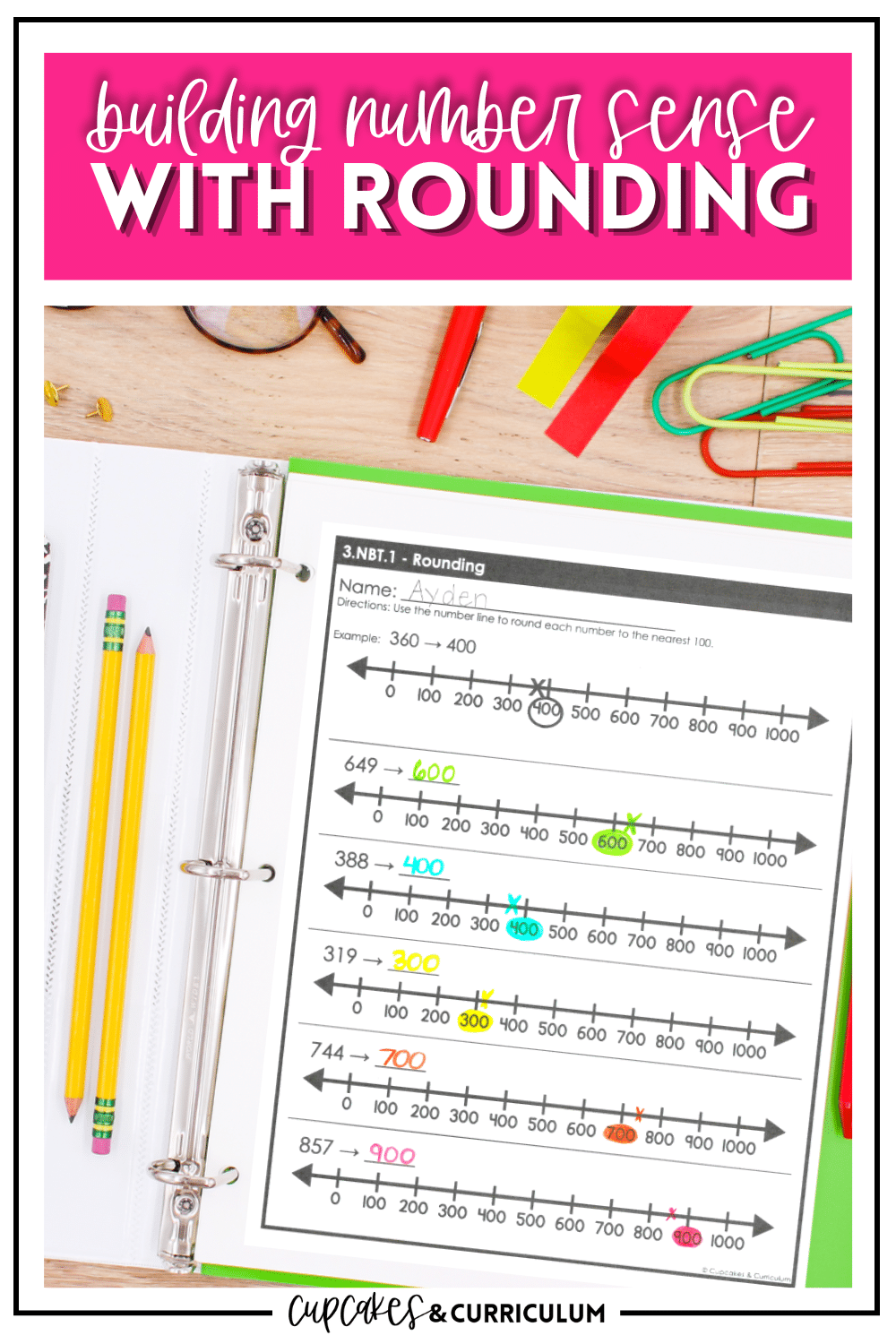
Rounding to the nearest 10 and 100 can feel like one of those skills students just need to “memorize.” But when we rely only on the old “5 or more, let it soar” rhyme, we’re teaching a trick instead of real understanding. This post shows how to move past shortcuts and give students a true foundation in number sense, so rounding makes sense—and sticks!
Rounding isn’t about repeating a rhyme. It’s about number sense. When students understand the structure of our base-10 number system—tens, hundreds, midpoints, and distance between numbers—rounding becomes a natural step, not a memorized trick.
Sure, the rhyme “5 or more, let it soar; 4 or less, let it rest” sounds catchy, but it doesn’t help students see why a number like 46 rounds to 50. Without that understanding, kids either memorize steps they forget the next day or apply them incorrectly when the numbers get bigger.
By teaching rounding as part of number sense, you’re building a foundation students will carry into estimating, multi-digit operations, and even decimals. You’re not just teaching them how to round; you’re teaching them to think flexibly with numbers.
When teaching rounding to the nearest 10, start with a number line. Have students place 46 on a line between 40 and 50. Suddenly, it’s not about remembering a rule—it’s about visually seeing which ten is closer.
Tips for success:
Rounding to the nearest 100 works the same way, but with larger jumps. A number like 362 falls between 300 and 400. On a number line, or using place value blocks, it’s clear which hundred is closer.
Tips for success:
Once students can round to the nearest 10 and 100 separately, combine the two. This prevents them from turning rounding into a one-size-fits-all shortcut. It forces them to read the question, identify the place value, and think about the number’s distance from the tens or hundreds.
Practical ways to practice both:
Rounding to the nearest 10 and rounding to the nearest 100 should never be about memorizing a rhyme. It should be about understanding how numbers work. When students see rounding as part of number sense, they aren’t just reciting rules—they’re developing a math skill that will support them in every grade level ahead.