
It’s the first week of August and I’m already laminating things. If you’re nodding, you know exactly where this is going. Your classroom is half set, your roster is still shifting, and somewhere in your open tabs you have a parent newsletter that’s been almost done for four days.
Here’s something that takes one thing off your plate: a ready-to-use list of August vocabulary words your students can actually use this month. Not abstract textbook vocab. The words for what students do in your classroom, how they feel on the first day, and what August looks and smells like before the leaves start to turn.
Below you’ll find 40 August vocabulary words organized into four themes, plus five practical ways to use them this week. There’s also a free printable at the bottom with every month of the school year, in case you want the whole vocabulary plan handed to you in one PDF.
Vocabulary depth is one of the biggest things separating strong readers from struggling ones by third grade. We all know it, and we all still under-teach it because there’s never enough time.
A monthly word list fixes the time problem. Pick the list once. Teach the words across subjects in five-minute pockets you already have built into the day. Morning meeting. The line up to lunch. The two minutes between math and recess.
And here’s the part that makes the words actually stick: the seasonal anchor. Kids remember “harvest” better when you’ve taught it in October than when it appears as word fifteen on a generic list in January. Their brains hold onto context, especially context they’re living in right now. Tying words to a season builds that context for you, with no extra prep.
Monthly word lists also scale across grade levels, which matters if you teach a multi-age group, a pull-out, or a class with a wide range of readers. The same August vocabulary words work for first graders learning to define them and third graders using them in writing prompts. You’re not building three separate vocabulary plans. You’re scaling one.
Here are 40 words I’ve used with first through third graders during the first weeks of school. They’re grouped into four themes so you can teach them in chunks, post each theme as its own section of your word wall, or rotate one theme per week through August.
These are the verbs your students will hear and use every day during the first weeks. Front-loading them gives kids shared language for what your classroom expects.
This list might do the heaviest lifting of the four. Naming a feeling is the first step to managing it, and the first day is loaded with feelings nobody warns kids about. Use these words in morning meeting check-ins all month.
Adjectives are gold for early writers. These words help students describe their experience instead of falling back on “good” and “fun” for everything.
August sits in between two seasons. Kids are still in flip-flops and watermelon, but the school year is starting. These words give kids a way to write about summer before they let it go.
You don’t need a separate vocabulary block to teach these. The whole point of a monthly list is that the words live in the corners of your day!
Pick one word per morning. Show it on the board, say it together, ask one or two students to use it in a sentence about something happening today. Three minutes total. Across August, you’ll touch each word twice.
Post the four themed lists as four small word walls instead of one big one. Students can move a word from “we’re learning” to “we know it” once they’ve used it in a sentence three times. The visual progress is motivating, especially for the youngest readers.
Give each student a simple folded booklet for the month. Each page gets one word, a student-written definition, an illustration, and a sentence. Pull the journals out for five minutes during transitions. By the last week of August, they’re little keepsakes. If you want more practice ideas, ten ways to practice words from any list gives you a stack of low-prep options that work with any monthly list.
Whenever you read aloud, pause if you hit one of the August vocabulary words. Even a quick “did you catch it?” trains kids to notice the words showing up outside the lesson. Pair this with strong first day of school read-alouds and you’ll hear words from the list coming back in student writing within two weeks.
Once or twice a week, end the day with a sticky note. Pick a word from the current week’s theme and ask students to use it in a sentence about their day. Filing these in a folder gives you running formative data without any grading.
If you’re building out a full word work block alongside this, the best word work centers walks through the rotations I use in my own classroom.
I made you something! Drop your email below and I’ll send you a printable PDF with every month of the school year. That’s twelve themed word lists ready for your word wall, your sub plans, your morning work, your vocabulary journals.
It’s the resource I wish someone had handed me my first August. No catch, no quiz, no upsell required. Just the lists, formatted clean and ready to print.
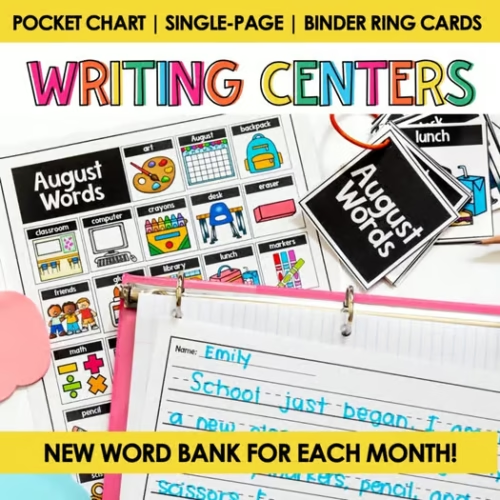
The free word lists above give you the actions, feelings, and seasonal vocabulary for August. If you also want the concrete classroom nouns (backpack, cafeteria, project, friends, science) presented as picture-supported cards your students can use to run an independent writing center, my Word Bank Writing Centers bundle does exactly that.
It’s a different kind of vocabulary support, and the two work side by side, not instead of each other. Your students grab a card with both the picture and the word, then use it as inspiration and spelling help while they write. You set up the center once, students grab and go, and you get your small group time back.
What’s inside the bundle:
It’s the difference between “go to the writing center” and “go to the writing center while I run guided reading.”
Get the Word Bank Writing Centers Bundle on TpT →
I built it for first through third grade. Kindergarten teachers can pull from the simpler categories (Late Summer, Words to Describe School) and skip the harder ones. Fourth grade teachers can use the list as a baseline and add three or four stretch words per week.
Yes, and this is one of my favorite things about a themed monthly list. The words don’t change, but how you use them does. First graders define them and draw them. Second graders use them in sentences. Third graders use them in paragraphs and start playing with synonyms. One list, three years of mileage!
Yes. The free printable above is the full school year, August through July. You’ll get all twelve months in one PDF, and I’m publishing a blog post for each month as the year goes on so you can see exactly how I’m teaching that month’s words.
The list isn’t built from a specific standard, because monthly themed vocabulary doesn’t fit neatly into a single CCSS strand. The way you’ll teach the words (using context, building academic language, applying words in writing) lines up directly with the Common Core vocabulary acquisition standards for grades 1 through 3.
If you’re staring down the first week of school and need backup beyond vocabulary, helping your students settle into the new year and first day of school activities are both worth a few minutes. And if you grab the printable, you’ll get a short note from me each month with the new word list and what I’m doing with it. One teacher to another.
If you skipped past it, the Word Bank Writing Centers bundle is here.