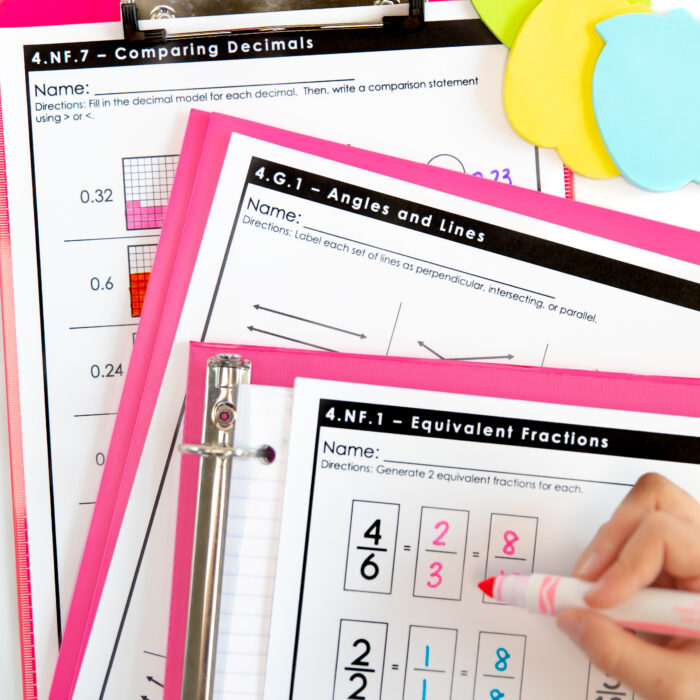
4.NF.1 – Equivalent Fractions
- Decompose shapes to create equivalent fractions (2 pages)
- Circle equivalent fraction from a set (1 page)
- Shade in and name equivalent fractions using fraction bars (2 pages)
- True/False (2 pages)
- Generate equivalent fractions (2 pages)
- Circle equivalent fractions from a set (1 page)
4.NF.2 – Comparing Fractions
- Write <, >, or = when given 2 fractions with uncommon denominators (2 pages)
- Order a set of fractions with uncommon denominators from greatest to least (1 page)
- Order a set of fractions with uncommon denominators from least to greatest (1 page)
- Name fractions and then compare using <, >, or = (2 pages)
- Determine true and false inequalities (2 pages)
- Name a fraction in between 2 given fractions (2 pages)
4.NF.4 – Multiplying Fractions
- Decompose fractions to make multiplication expressions (2 pages)
- Use a number line to solve a whole number multiplied by a unit fraction (2 pages)
- Multiply the fractions using a model (2 pages)
- Multiply the fractions using a number line (2 pages)
- Word problems (2 pages)
4.NF.5 – Equivalent Fractions | Tenths and Hundredths
- Write an equivalent fraction when given a fraction with 10 or 100 in the denominator (2 pages)
- Name a fraction based on a model, then name the equivalent fraction (1 page)
- Add fractions with 10 and 100 in the denominator (3 pages; varying difficulty)
- Shade in a model to make an equivalent fraction, then name the fractions (2 pages)
- Name fractions, then add when given a model (2 pages)
4.NF.6 – Fractions as Decimals
- Convert fractions to decimals (4 pages)
- Convert decimals to fractions (2 pages)
- Fill in fraction, word form, or decimal form (2 pages)
- Write fraction and decimal based on model (2 pages)
- Write a decimal and place on number line when given fraction (2 pages)
4.NF.7 – Comparing Decimals
- Compare decimals using >, <, or = (2 pages)
- Place decimals on number line, then compare (2 pages)
- Draw decimals on model, then compare (2 pages)
- Circle which the decimal is closest to: 0, 1/2, or 1 (2 pages)
- Order 3 decimals from least to greatest (1 page)
- Order 3 decimals from greatest to least (1 page)
4.NBT.1 – Place Value
- Fill in the blank to show value of underlined digit (2 pages)
- Fill in the blank to show place value of underlined digit (2 pages)
- Compare value based on place (2 pages)
- Write number when given rule (2 pages)
- Fill in the blanks to make number sentences true (2 pages)
4.NBT.2 – Number Form and Comparing Numbers
- Answer questions about a given number (2 pages)
- Identify numbers in a set with largest or smallest value (2 pages)
- Make the greatest and smallest numbers possible when given a set of digits (2 pages)
- Answer true or false to a number comparison and explain thinking (1 page)
- Write > < or = to make a given statement true (1 page)
- Write a number that fits the description (1 page)
- Write numbers in expanded form (1 page)
4.NBT.3 – Rounding
- Complete number lines and round to given place value (2 pages)
- Round numbers to a given place value (2 pages)
- Round a number to nearest 10 and 100 (2 pages)
- Use open number lines to round to nearest 100 (1 page)
- Use open number lines to round to nearest 1000 (1 page)
- Name numbers that fit a description and explain thinking (2 pages)
4.NBT.4 – Add and Subtract
- Subtract with no borrowing (3 pages)
- Subtract with borrowing (5 pages)
- Subtract across zeroes (2 pages)
- Add with no carrying (2)
- Add (8 pages)
- Find the missing addend (4 pages)
4.NBT.5 – Multiplication
- Multiply 2- 3- or 4-digit numbers by 1 digit numbers (5 pages)
- Multiply 2-digit by 2-digit numbers (5 pages)
- Multiplication word problems (5 pages)
4.NBT.6 – Division
- Divide 2- 3- or 4- digits by 1-digit no remainders (2 pages)
- Divide 2- 3- or 4- digits by 1-digit remainders (2 pages)
- Divide 2- 3- or 4- digits by 1-digit mixed (6 pages)
- Division word problems (5 pages)
4.OA.1 – Interpreting Multiplication Equations
- Write a multiplication equation when given a comparison statement (3 pages)
- Write a comparison statement when given a multiplication equation (3 pages)
- Solve multiplicative comparison word problems (4 pages)
4.OA.2 – Multiplicative Comparison Word Problems
- Solve multiplicative comparison word problems (8 pages)
- Write a multiplicative comparison word problem when given an equation (2 pages)
4.OA.3 – Multi-Step Word Problems
- Solve multi-step word problems (10 pages)
4.OA.4 – Factors/Prime & Composite Numbers
- Find factors for given numbers (2 pages)
- Answer YES/NO questions about factors; explain reasoning (1 page)
- Use arrays to prove/disprove a statement about factor pairs (1 page)
- List multiples of given numbers (2 pages)
- Color prime numbers and explain what a prime number is (1 page)
- Color composite numbers and explain what a composite number is (1 page)
- Circle prime or composite numbers in a given set of numbers (2 pages)
4.OA.5 – Rules and Patterns
- Use tables to solve word problems (1 page)
- Use given rule to continue the pattern (2 pages)
- Observe the pattern to identify the rule (1 page)
- Identify the rule, then complete the pattern (1 page)
- Match a given pattern to its rule (2 pages)
- Extend a repeating visual pattern (1 page)
- Predict what a future visual pattern will look like (2 pages)
4.G.1 – Angles and Lines
- Label angles as right, obtuse, or acute (2 pages)
- Label lines as perpendicular, parallel, or intersecting (1 page)
- Label lines and angles using word bank (1 page)
- Answer questions about angles in shapes (1 page)
- Indicate whether a shape has perpendicular lines, parallel lines, both or neither (1 page)
- Draw shapes, lines, or angles with given properties (2 pages)
- Answer questions about lines and angles based on a map (2 pages)
4.G.2 – Classify Shapes
- Label triangles as right, acute or obtuse (1 page)
- Use a set of polygons to answer questions (2 pages)
- Draw shapes with given properties (1 page)
- Indicate angles, sides, and more by completing a table (3 pages)
- Match the shape to its description (1 page)
- List 3 properties of a given shape (1 page)
- Cut and paste quadrilaterals into the correct category. (1 page)
4.G.3 – Lines of Symmetry
- Recognize and label lines of symmetry in the alphabet (2 pages)
- Recognize lines of symmetry as vertical, horizontal, or diagonal (1 page)
- Pick shape that isn’t symmetrical out of a set; draw lines of symmetry on other shapes in set (1 page)
- Pick objects that shows correct drawing of lines of symmetry in a set (2 pages)
- Draw lines of symmetry in objects (2 pages)
- Complete the drawing (2 pages)
4.MD.1 – Measurement (Metric and Customary)
- Convert customary measurements (4 pages)
- Convert metric measurements (2 pages)
- Convert measurements from a table (8 pages)
- 2 conversion charts included (1 metric, 1 customary)
4.MD.2 – Measurement Word Problems/Story Problems
- Solve word problems involving units of measurement (10 pages)
4.MD.3 – Area and Perimeter
- Find the area and perimeter of quadrilaterals (4 pages)
- Find the value of one side and the perimeter when given the area of a shape (4 pages)
- Area and perimeter word problems (2 pages)
4.MD.4 – Line Plot/Fraction Addition and Subtraction
- Plot given data on a line plot and solve addition and subtraction equations based on the data (10 pages)
4.MD.5 – Angles and Fractional Parts of Circles
- Determine if an angle is right, obtuse or acute when given a measurement (3 pages)
- Calculate the angle measurement of an angle in a circle when given the fractional part (3 pages)
- Choose the most logical measurement when given a picture of an angle (4 pages)
4.MD.6 – Measure and Draw Angles
- Use a protractor to measure the angles (6 pages)
- Label a measurement as acute, obtuse, or right and draw a sketch of the angle (4 pages)
4.MD.7 – Additive Angles
- Find the missing angle measurement when given a line/one angle (3 pages)
- Find the missing angle measurement in a triangle (2 pages)
- Find the measurement of a missing angle, then draw an angle given a description (5 pages)